Awareness in Physical and Mental Changes in the Bioart of Roy Ascott
“Stellarc, Edward Kac, Orlando, Amy Karle, Anna Dimitriu, Marta de Menezes, Suzanne Anker, Laura Splan and George Gessert are some of the main authors of bioart.”

“Stellarc, Edward Kac, Orlando, Amy Karle, Anna Dimitriu, Marta de Menezes, Suzanne Anker, Laura Splan and George Gessert are some of the main authors of bioart.”
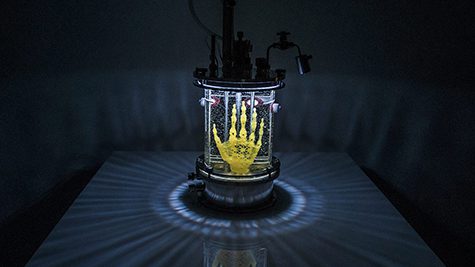
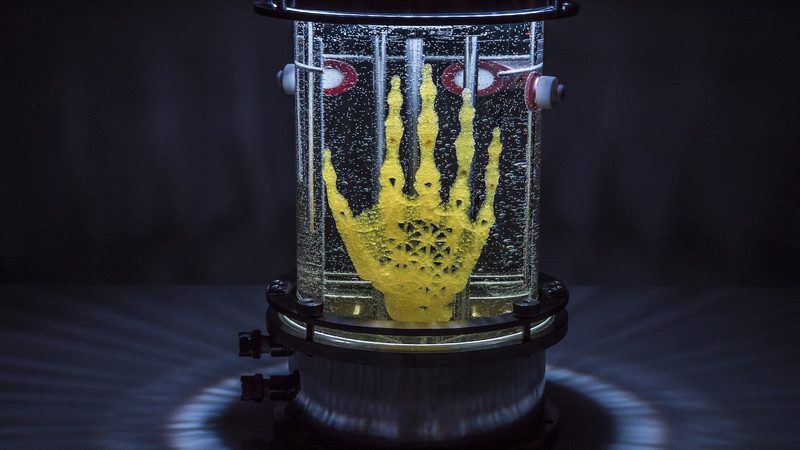
“Amy Karle is an American bioartist who has ventured into 3D sculpture, performance and even fashion with designs made in the likeness of veins, arteries and internal organs of the human being.”
As part of the “first ever all female speaker 3D printing conference”, industry leaders Amy Karle, Chengxi Wang, Jenny Chen and Laura Kastenmayer discuss “Pushing the Limits of Additive Manufacturing in Healthcare” including: creativity and innovation; accessibility, education, collaboration; digital & additive manufacturing to support ending the covid-19 pandemic; how panelists would ultimately push AM in healthcare if the sky’s the limit
Satori CEO Chengxi Wang and BioArtist Amy Karle discuss how 3D printing is affecting biotech, and how this affects what is might mean to be human. Amy Karle also shares how accessible 3D printing is becoming as we discuss the importance of a variety of perspectives in the 3D printing industry.

“With degrees in Philosophy and Art and Design, Amy Karle’s work explores the deep questions at the intersection of the human experience and technology: What happens when technology surpasses humanity? Can we use technology to indefinitely prolong life? How does technology enable life after death? How might we use technology to redesign the human body?” ISBN:9789004447592, 9004447598

How can art support science? And how can science support art? Follow the discussion between award-winning Artist Amy Karle and Erasmus MC’s research team Roberto Narcisi, Enrique Andres Sastre and Yannick Nossin who believe these two fields go hand in hand with each other. In the end, aren’t art and science seeking for the same answers? How will science and all its data look like in the future? And what essential role can art take in this?

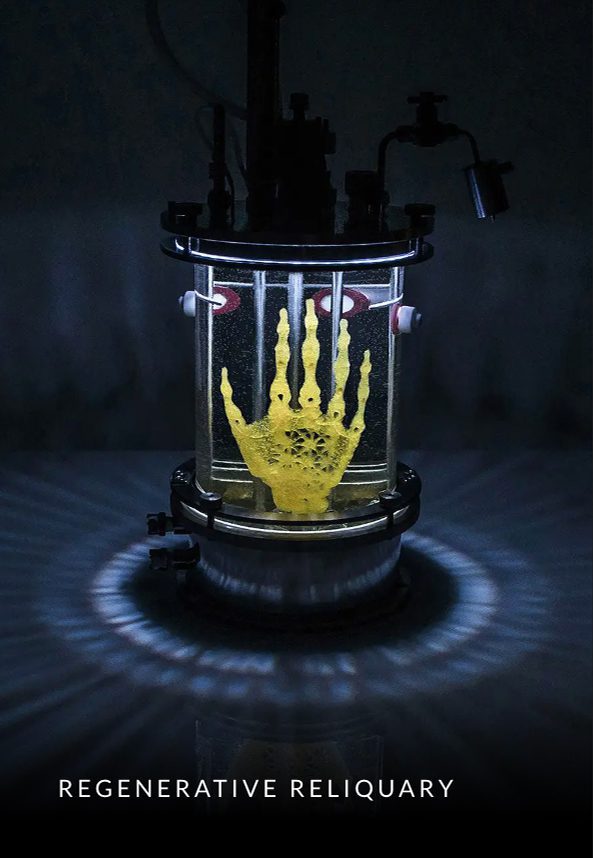
Get to know the artists of (UN)REAL! Who are they? What kind of art do they make, and what is their (UN)REAL artwork about? In this video you will get to know each artists that have participated in (UN)REAL exhibition at Science Gallery Rotterdam including Amy Karle who created Morphologies of Resurrection.
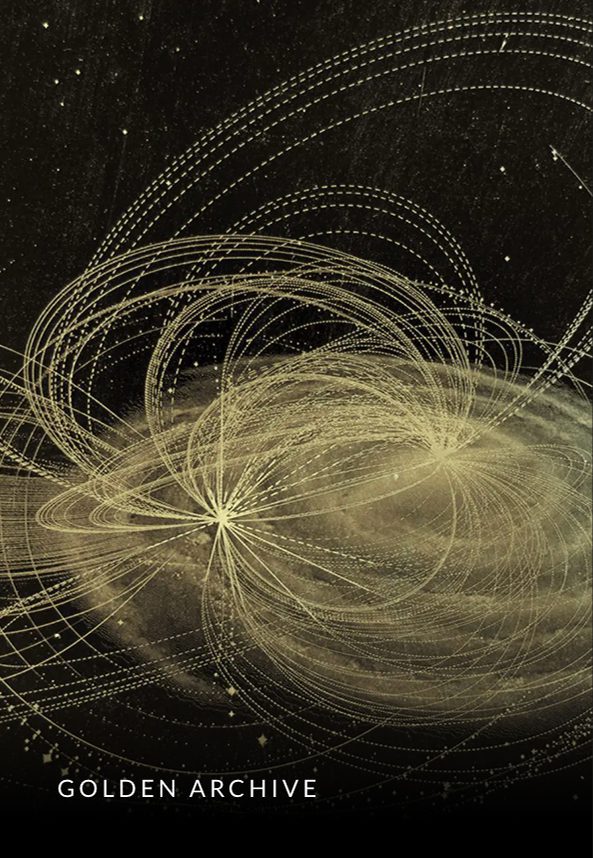
Earlier in the year, Ars Electronica partnered with. art Domains to launch an online exhibition space for the festival’s inaugural 2020 online edition. The .art Domains offered the participants also to take advantage of one of their new online solution called the .art Digital Twin.

Bio-artist Amy Karle (2020) brings feminist critical reflexivity into her works in which she integrates art, science, and technology toward goals of healing and improving bodily functions.

More than ever people are asking, what’s real? How did this ever become an urgent question for our daily lives, a matter of ever greater disagreement and discord? “Are We As Gods? Bio Reality with Amy Karle” begins ~35:30 Amy Karle is an internationally award-winning bioartist working at the nexus of where digital, physical and biological systems merge. Her art and enquiry explores ethical questions about our god like power to author in biological and genetic media, and ultimately asks how we might create a positive better future and not a dystopian one.
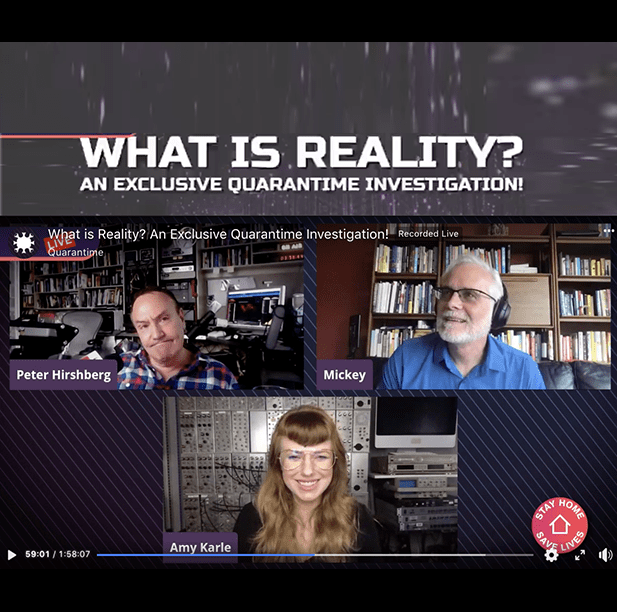
For many artists, the expression of the human condition comes through pain. Emotional, psychological toiling expelled into the world. Perhaps no one’s artistic trauma manifests more materially than the work of Amy Karle. Amy grew up with a rare and dangerous genetic disorder known as aplasia cutis, the missing of skin on the scalp. From such beginnings, Karle pioneered a new form of artistic expression: Bioart…It’s a style of art just past the threshold of science–experimentation for the sake of creativity in lieu of medicinal remedy.

What does it mean to be alive at this time of evolution and technology merging? And how can art and science merge into a common goal? Artist Amy Karle and scientist Roberto Narcisi explain.
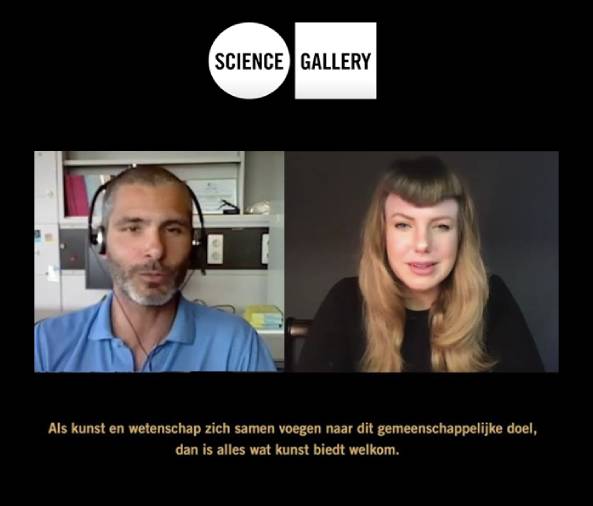
What does it mean to be alive at this time of evolution and technology merging? And how can art and science merge into a common goal? Artist Amy Karle and scientist Roberto Narcisi explain.

There is also a group of artists like Amy Karle who have managed to find a new way to explore art from these technological advantages. Karle uses what she sees as “exponential technologies” and incorporates additive manufacturing technologies “because it has the potential to create more organically, it is more like the intelligence of how nature is formed and grows.” For this artist, the use of new technologies makes nature much closer to its forms…Thanks to additive manufacturing technologies related to many industries, such as the medical industry, the development of materials, 3D printing in construction, artists are allowed to…
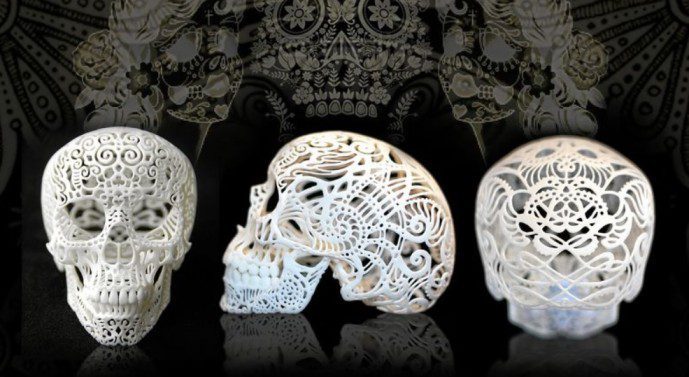
Artist Amy Karle comments, “I use technology as a mirror to the self, to who we are and to who we can become. My work questions and maps the new world of humans merging with technology, and what could be done to shape a more positive future. My Digital Twins that are featured in the Ars Electronica. ART Gallery … examine material and spiritual aspects of life, opening visions of how technology could be utilized to support and enhance humanity. The projects probe how exponential technology and interventions could heal and enhance the body – and even alter the course of evolution.”

Technological progress is often understood as the opposite pole to nature and organicity, however some artists seek to create bridges between technology and human experience. Among them, the American artist Amy Karle stands out… Amy Karle shows us that technological devices can be tools to better understand and reflect on the condition of being human. How the paths of technology and organic can intertwine, creating extremely productive connections (translated).
Introduction to the (UN)REAL exhibition at Science Gallery Rotterdam exhibiting Amy Karle’s artwork, Morphologies of Resurrection, 2020. (translated)
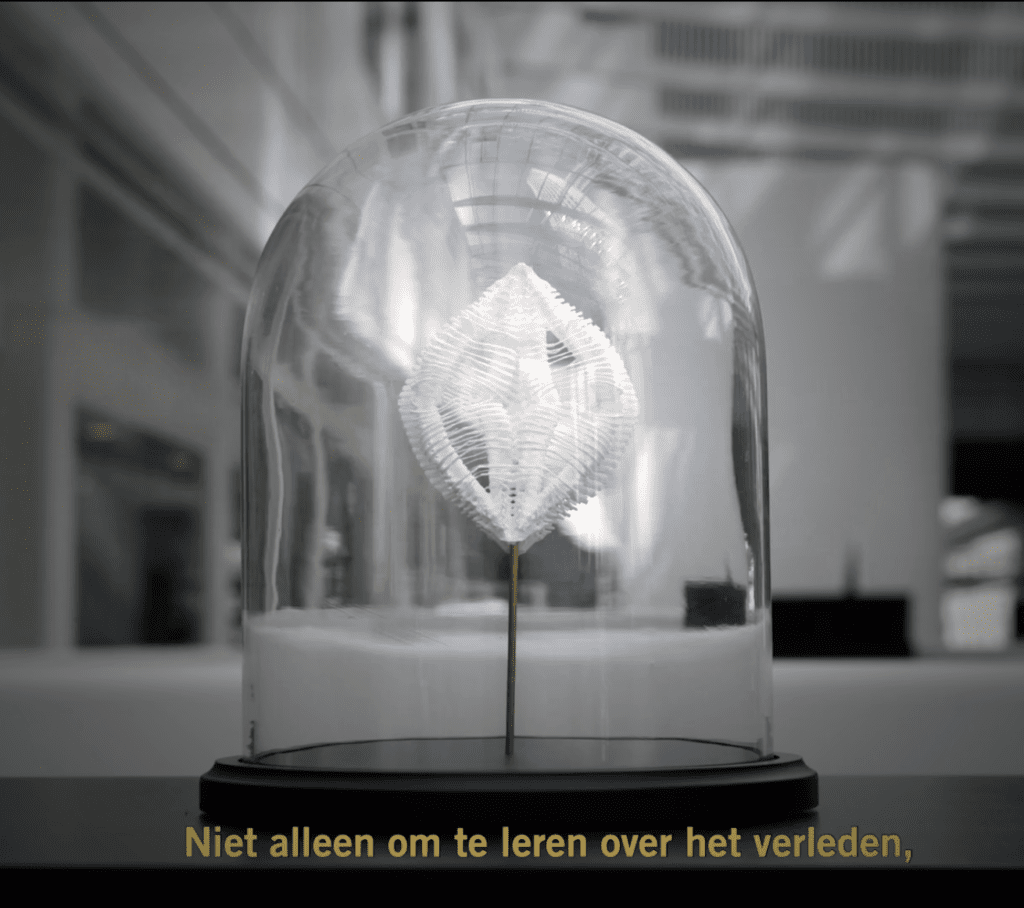
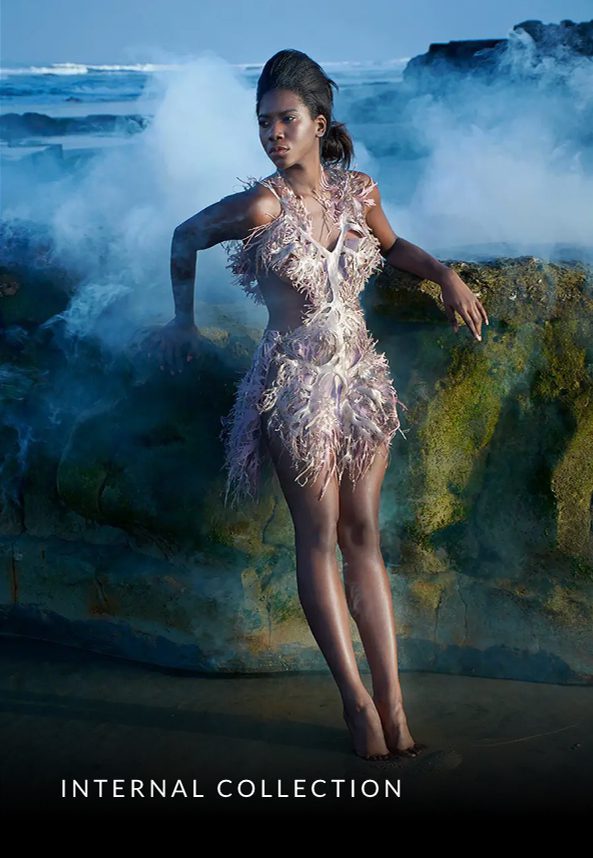
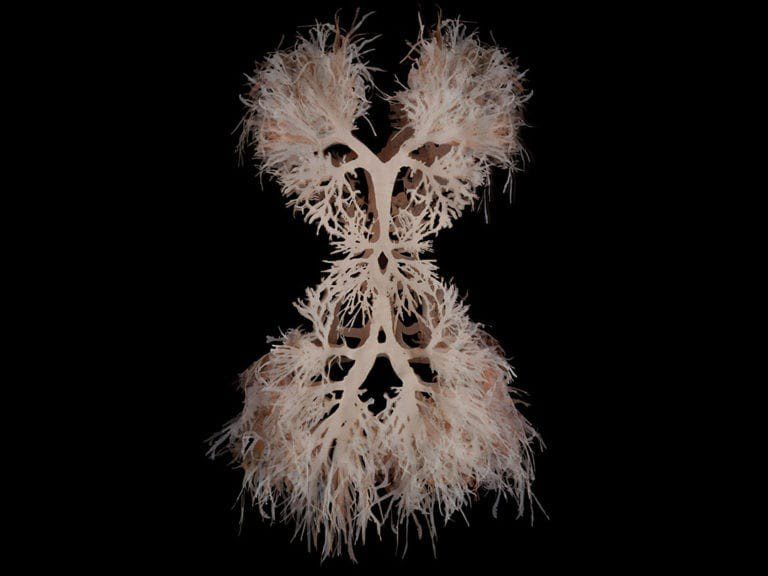
Amy Karle has crafted an extraordinary line… The materials mimic the pulmonary system, blood vessels, ligaments and tendons or the nervous system literally turning the wearer’s battle for life inside out. …Bioengineering, genetic engineering and other forms of biotechnology were explored as solutions to treat incurable diseases and even improve all types of performance… bio artworks included The Heart of Evolution (2019), a higher performance human heart created by Amy Karle – exploring to what degree humans should change their bodies.

Internal Collection, 2016-2017 series of fashion designs by Amy Karle, that imitate human body features such as ligaments and tendons, pulmonary and nervous system… The intention to imitate bodily organs is quite innovative and a striking artistic intention, these ‘organic’ designs connote sexuality and desire… Until present day, nudity has always been a political taboo, in most cultures it is prohibited. Such artistic intention suggests that sex has been used as a political tool for control… This biopolitical enigma questions our notions of dress code, where sex in general has been something secretive, difficult to reach and in order to…
What is real, and how are you sure it is so? Can you be confident in your perceptions when so many experiences are digital or influenced by the changing chemistry and architecture of your brain? (UN)REAL, the inaugural exhibition of Science Gallery Rotterdam at Erasmus MC, presents art projects that respond to this fertile terrain between the actual and the perceived. Includes Amy Karles artwork… These works can serve as bridges of understanding and platforms for debate, but perhaps even more important, they are welcome signs, announcing a new meeting place for research, society, art, and healthcare.